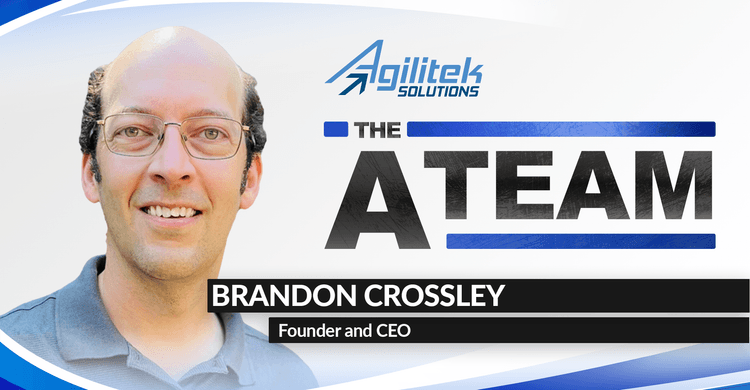

The A-Team is a series of conversations with the people at Agilitek who build and run sports data systems. These are their stories. Brandon Crossley is Agilitek's CEO. He grew up in Yellowknife and got into sports data through a Vancouver software shop that had nothing to do with sports when he joined it. That company became KORE Software, which was the foundation he built his career on before he founded Agilitek in 2019.
Table of contents
- Key Highlights
- Overview
- Solution
- Results
Interested in learning more?
Book a demo today to learn how Agilitek can support your business goals!Book a DemoWhere did you grow up, and how did you end up in sports data of all things?
I was born and raised in Northern Canada, in a place called Yellowknife, Northwest Territories, and knew from age 7 that I was going to be a software developer when I grew up. My family moved to Vancouver in my youth, and shortly after graduating from university I landed my one of my first “real jobs” at a small local tech startup that would eventually become KORE Software – a scrappy hole-in-the-wall shop with three people at the time. A few years into my tenure there we gained our first sports customer and (to cut a long story short) ended up focusing exclusively on sports and quickly growing into a highly recognized name in the space. I ended up spending over 14 years there, so that's how and where I cut my teeth on all things sports data.
What do you actually do on a Tuesday?
You had to pick Tuesday, didn't you. Tuesday is meeting marathon day, it is jam-packed. A couple of early morning internal standups with the implementation teams and product teams, then weekly update calls with some of our biggest clients through late morning and early afternoon, usually sneaking a quick lunch during one of them. Then a weekly priority planning meeting, so everything coming in from clients gets slotted into the right spots in people's work lists. That leaves an hour or two for contracting and sales activities and administration. I always prioritize dinner with the family, then catching up on a backlogged inbox in the evening.
What common stumbling blocks or mistakes do you often see in implementations?
Lots. Where do I start? I’d say one that comes to mind is paralysis caused by trying to achieve perfection. The fallacy that you only have one shot to make changes can get in the way of meaningful progress. We're big fans of iterative delivery, of failing forward, of minimizing risk by shortening cycles, and getting feedback from users as quickly as possible. Most organizations talk a good talk about having a culture of continuous improvement and learning, but many don’t practice what they preach in how they approach implementations.
What do most teams get wrong about their own data?
I’m not sure it’s a case of teams “getting things wrong” about their data, as much as it is an observation I have, but I'll share that I often see different departments have different perspectives about their own data. I'm going to contrast how data teams and business intelligence teams look at data versus how marketing looks at data. BI teams are traditionally the people we’ve worked with most closely, and they tend to place a high value on precision and individual record accuracy and high standards around data quality, and obviously I have a certain affinity towards that view.
But on the marketing side, the mandate is a little bit different, and there is relatively more value placed on directional and inferred data – trying to tease out as many insights as possible even if they are not perfectly accurate. Third-party enrichment data is one of many examples, where it serves truly useful purposes but maybe doesn't hit a certain standard of accuracy. Partnerships teams have a similar perspective to marketing – a strong desire to look at things in aggregate, to extrapolate, to understand audiences, even if it's not first-party data.
The best data platforms and BI teams understand those differences and have ways to incorporate those styles of data within one platform, providing nuanced views of fans that can distinguish between high confidence vs low/medium confidence data and can use both responsibly for appropriate use cases.
What do you look for when evaluating new technology?
Being a smaller-sized tech business, one of the things I look for in every purchasing decision is cost to value (naturally), but also the switching cost in case our business needs change or we were simply wrong in our selection. We're a nimble business, so we’re always trying to limit our risk, and minimize the costs of being wrong, so that we can afford to be decisive and move quickly, and pivot when needed.
The other thing that is extremely important is understanding if there's a hidden cost. ie: If any platform is benefiting from my business’s data, I try to factor that into the cost equation in some way. Data is an undervalued asset that is oftentimes shared or given without sufficient thought or value attached to it. I mean personally, when I sign up for something as a consumer, I recognize that oftentimes if the product is free, I am the product. But at an enterprise level, I think we often forget that this is also true – our own business data, and the data we hold on our consumers, is sometimes shared with our vendors to their benefit. I’m proud of the fact that Agilitek has taken a very strong and unique stance on providing products that enhance our customer’s data sovereignty, security, and privacy, and do not aggregate or monetize our customer’s data in any way.
What is the part of a build that nobody notices when it is done right?
There's so many little things! One of the ones I'm proud of in our own Fan Data Platform, that people notice but don't necessarily appreciate, is the amount of self-service configuration we offer. There's a lot of purposefulness to it, which builds confidence and offers freedom. We try to build most everything to be flexible enough that our team is not needed to configure it. When developers aren't needed for high touch maintenance and configuration, that is the sign of a thoughtfully-built software. As a software developer and engineer myself, I like things done well more than quickly, and a lot of that quality behind the scenes doesn't get noticed but is ultimately the source of long-term satisfaction.
What is something you have changed your mind about in the last two years?
I'd have to put AI in this category. I almost feel like that's a cop-out answer, because very few people two years ago would have predicted where it would be now. That was me for sure. I never doubted it would become a really good mimic and a speed enhancement tool that developers could use to write code faster. What I’ve changed my mind on is how much of the development process can be dramatically accelerated, including moderately complex tasks.
What remains interesting though is that the productivity boost seems to correlate to your expertise as a developer, so the strongest developers are also the ones getting the best productivity boost, while this does pose a problem for less experienced developers, who now have two simultaneous uphill battles – gaining experience in a world where fewer entry level developer jobs exist, and finding ways to keep up with senior developers who are multiplying their productivity with AI. It will be interesting in a few years to see the how the employment landscape evolves given these changes.
A team, brand, or campaign that has your attention right now?
The college sports space has more storylines than I could even begin to list out, and it's an area I historically have not followed, so I'm still trying to get up to speed on all the history and what impact all the recent and incoming changes will have. Also, curious to see how the soccer landscape evolves and if the increased attention from the World Cup will translate to growth of the MLS over the coming years.
If you could only play one piece of music on the piano for the rest of your life, what would it be?
That’s a horrible question! There’s 300yrs of music to pick from! Can I at least pick a book or set of music? I could possibly narrow down to just one composer – that would be Scriabin. But if it had to be one book, I couldn’t possibly choose between Bach’s Well Tempered Clavier or Chopin’s Ballades or Etudes. If my family had to listen to it forever, maybe Gershwin's Rhapsody in Blue? … oh, but maybe I’d actually pick Franck’s Prelude Chorale and Fugue -- I could play that on loop for hours on end!